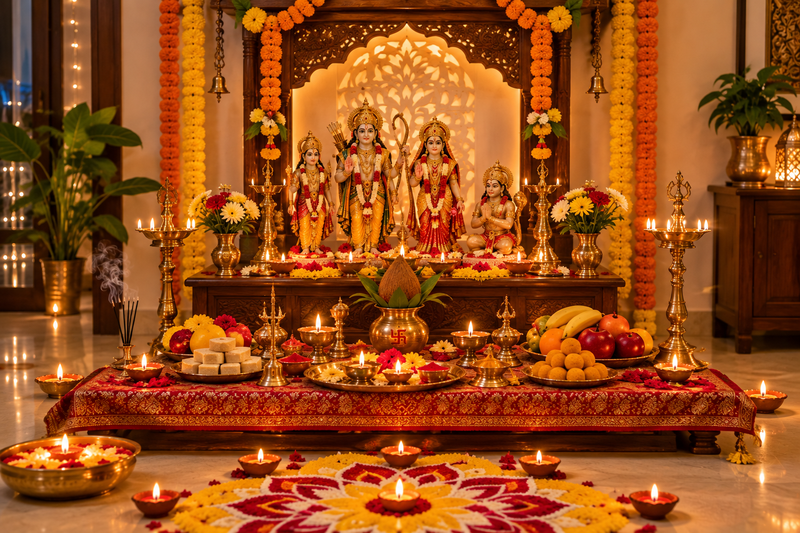
Lamp offerings related to Yama and ancestors are present in various Indian traditions, yet they do not constitute a single, uniform Choti Diwali ritual throughout Kerala. Kerala's Diwali participation itself varies between communities and households. A careful account leaves space for that diversity.
Ask which tradition is being described
The term Yamadeepam can denote a family lamp ritual, a temple ceremony, or a more general devotional concept. It is important to specify the community, time, and intent before adopting its guidelines. Customs from one region should not be applied to another simply under a general southern classification.
Keep remembrance simple
A family may kindle a supervised lamp in their regular prayer area, honor a relative, and share a story. Adhere to customary household traditions for offerings and prayers. Those unfamiliar can observe quietly without performing specialized rituals.
Avoid blending separate lamp festivals
Kerala and nearby areas observe other significant lamp-related festivals at various times throughout their calendars. A similarity in appearance does not mean they are variations of Naraka Chaturdashi. The names, seasonal context, and local interpretations are important.
Make the article useful at home
Record who upholds the custom and what significance it holds for them. If your household does not observe such a custom, a thoughtful reflection on ancestral memory suffices; there is no requirement to adopt a ritual simply because it appears in a general festival guide.