At a glance
- Diwali and Deepavali share the image of a row of lamps.
- The festival carries several religious and regional meanings.
- A meaningful celebration can centre on a few carefully chosen practices.
From a row of lamps to a season of celebration
Deepavali is a Sanskrit name commonly explained as a row or series of lamps. Diwali is a widely used form of the same name. Both belong naturally in contemporary writing and conversation; a family’s preferred word may reflect its language, region or upbringing. Neither name describes a lesser or more complete festival.
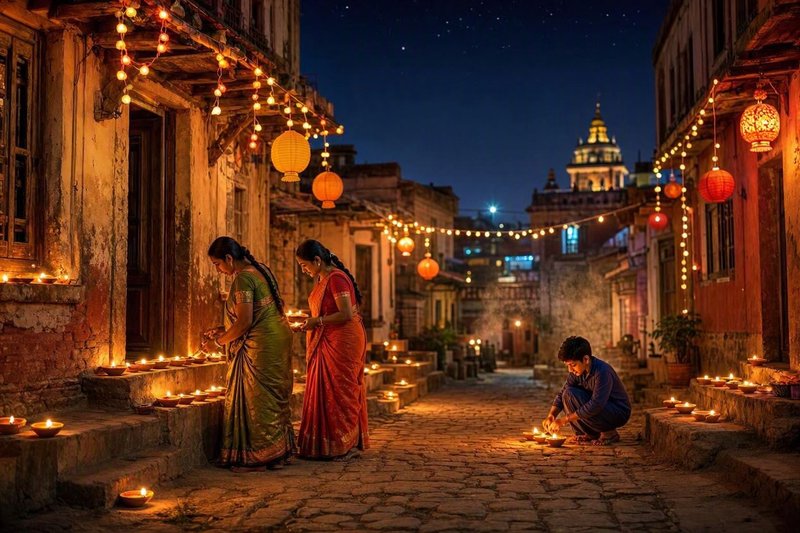
The image behind the name remains recognisable: a doorstep lit for visitors, a small lamp beside a family shrine, or a street bright with decorations. Yet the festival is larger than that image. Religious observance, shopping, cooking, cleaning, visiting and giving may all have a place. Which activities matter most depends on the people celebrating.
Why there is more than one meaning
Many Hindu families connect Diwali with Rama’s return to Ayodhya, while others foreground Lakshmi worship, Krishna traditions or Kali Puja. Jain and Sikh observances carry their own meanings, and Nepal’s Tihar and Newar Swanti add further traditions. The Rubin Museum’s cultural overview is a useful introduction to this variety.
These connections need not be collapsed into a single origin story. A person may grow up hearing several of them, while another household follows one devotional tradition closely. When describing a celebration, “In our family…” or “In this community…” often conveys more than a sweeping claim about what everyone does.
| Part of the celebration | A meaning it can carry | A thoughtful way to practise it |
|---|---|---|
| Lamps and illumination | Welcome, hope and clarity | Light a space where people can gather comfortably. |
| Cleaning and preparing | Renewal and care for the home | Share the work and concentrate on useful tasks. |
| Prayer and devotional stories | Gratitude, guidance and remembrance | Explain the family’s tradition to younger participants. |
| Food and gifts | Hospitality and affection | Choose what the recipient can enjoy and use. |
| Visits and greetings | Belonging and renewed relationships | Make time for a conversation, including with someone far away. |
Light as an invitation to pay attention
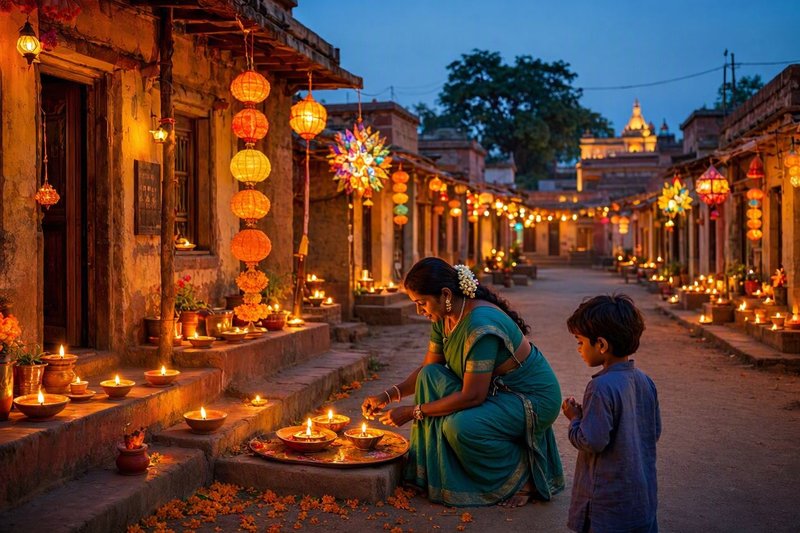
“Light over darkness” is a familiar explanation of Diwali. Families may understand that image through religious devotion, knowledge, courage, generosity or hope. It can be made concrete without turning it into a slogan: listen to an elder’s story, resolve a small disagreement, thank the person who cooked, or make room for a neighbour who would otherwise celebrate alone.
A beautifully lit home can be simple. One supervised diya, a reusable string of lights and an unhurried meal can create an atmosphere as meaningful as an elaborate display. The number of lamps does not measure devotion, and there is no reason to turn another household’s photographs into a standard your own celebration must meet.
Renewal includes the people doing the work
Preparations sometimes become so demanding that the host barely experiences the festival. A useful interpretation of renewal is to improve the way a household shares its time. Divide cleaning, shopping and cooking; decide which tasks can be skipped; and protect a period when everyone can sit together.
Business and household customs can also express a fresh start. Some families pray with account books or review their finances during the season. That symbolic renewal is compatible with ordinary practical care: clear records, affordable purchases and keeping promises. A blessing should never be presented as a guarantee of profit or a reason to borrow beyond one’s means.
Hospitality gives the festival a social shape
Sweets and gifts are visible expressions of welcome, but hospitality begins before the tray reaches the table. Ask about food preferences and allergies. Check whether a visitor needs a chair, an accessible entrance or a quieter place to sit. Explain what will happen during prayer so a guest can participate at a comfortable level.
For friends who do not share the host’s religion, joining a meal or offering a greeting can be enough. Participation should feel like an invitation. Similarly, a family that observes the season quietly, or marks a different religious occasion at the same time, need not imitate the practices of its neighbours to belong in the conversation.
Tradition can travel and change
An apartment may replace an outdoor courtyard; a video call may bring distant relatives to the same gathering; an inherited recipe may be adjusted to available ingredients. These changes deserve practical thought rather than anxiety about making the festival look exactly like a remembered childhood.
Choose a few anchors that carry your family’s memory: a story, a prayer, a dish, a greeting or a visit. Record their names and why they matter. The resulting celebration can be recognisably yours while leaving space for new members of the household and the circumstances of the present year. For the festival’s sequence, continue with the five-day guide; for different devotional connections, see Diwali across faith traditions.
Frequently asked questions
Are Diwali and Deepavali different festivals?
They are names for the same broad festival tradition. Usage varies by language and region, and the rituals associated with the season can vary too.
Does Diwali have one origin story?
No single narrative explains every community’s observance. Rama, Krishna, Lakshmi and Kali traditions coexist with distinct Jain, Sikh and Newar connections.
Can a small celebration still feel meaningful?
Yes. Choose the practices that matter to your household and give them time. The size of a display, meal or purchase does not measure a celebration’s value.
How can I explain Diwali to a guest?
Begin with what your own family celebrates, then mention that other communities may observe the season differently. Explain any prayer or food customs before inviting participation.
Sources & further reading
Calendar and event information checked 5 November 2026. Recheck local arrangements before attending.