At a glance
- Begin with the household’s devotional practice and an understandable sequence.
- Use manageable offerings and a safe, uncluttered space.
- Choose local timing separately from the practical preparation plan.
Understand the worship before arranging the table
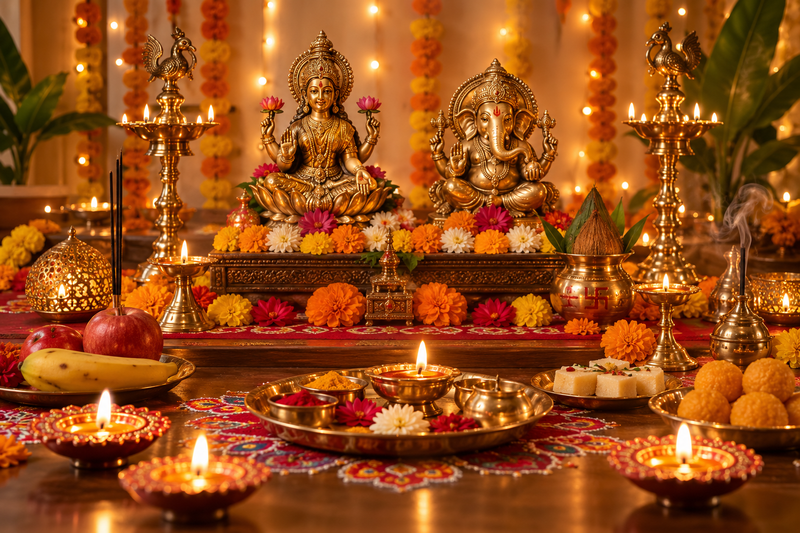
Many Hindu households worship Lakshmi during Diwali with prayers for auspiciousness, prosperity and wellbeing. Ganesha is often worshipped alongside her, associated with wisdom and auspicious beginnings. The pairing is familiar in many northern and western traditions, though it does not define every Hindu household’s Diwali.
A useful starting question is, “What does our family normally do?” An elder, temple or trusted priest can explain the prayers, order and offerings that belong to your tradition. If you are beginning a new household practice, choose a short form you can understand and carry out attentively rather than assembling every item mentioned online.
Decide who is leading and when to gather
Agree on a person to guide the sequence, someone to organise the offerings and someone to help children or guests. This keeps the host from answering every practical question during prayer. Tell everyone whether the gathering includes a meal and roughly how long to allow.
For a precise muhurat, consult a calendar calculated for the relevant city and the tradition you follow. A time copied from another country, timezone or previous year is not a dependable substitute. The date guide explains this distinction; this page intentionally gives a sequence without prescribing a universal clock time.
Set up a clean, usable space
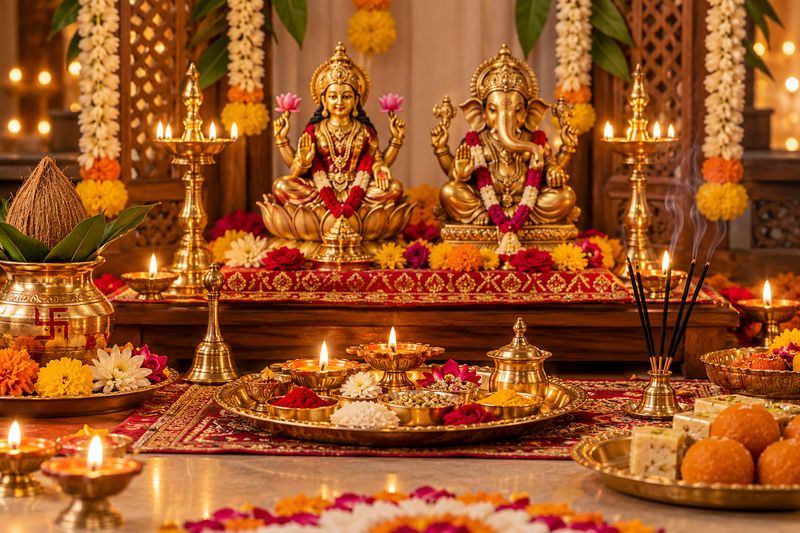
A chowki or another stable surface, a clean cloth and the images or murtis used by your household can form the centre. Arrange offerings so the person leading can reach them without leaning over flames. Allow enough space for people to sit or stand comfortably, and keep a chair available when floor seating is difficult.
Place any diya on a stable, heat-resistant holder away from cloth, paper, curtains and trailing clothing. Do not crowd several lamps between food dishes. The U.S. Fire Administration’s open-flame guidance supports stable holders, clearance from combustible materials and extinguishing flames before leaving or sleeping. Battery lamps are useful where an open flame cannot be supervised.
Gather a modest set of offerings
Common items include flowers, fruit or sweets, water, a thali, a diya with its usual fuel and wick, and roli or kumkum with rice where customary. Some households add incense, a bell, coins or account books. These are examples, not an instruction that every family must obtain every item.
| Purpose | Possible items | Practical decision |
|---|---|---|
| Devotional focus | Family images or murtis | Use the objects your household recognises and treats respectfully. |
| Offerings | Flowers, fruit, a small sweet dish, water | Choose manageable quantities and check food preferences. |
| Light | A diya and suitable holder | Provide a clear place and an adult to supervise it. |
| Prayer | A familiar text, song or reading | Keep the words available in a language participants understand. |
| Household or business custom | Coins or account books | Add them only when they are meaningful to your practice. |
A simple sequence you can adapt
- Prepare and settle. Finish the arrangement, wash as your custom requires and gather everyone before beginning.
- Open the worship. Follow the invocation or opening prayer used by your family. Explain it briefly for anyone unfamiliar with the sequence.
- Light the diya safely. Place it where it can remain undisturbed. A child can assist with non-flame tasks.
- Offer flowers, water or food. Use the offerings and order of your tradition; a simple arrangement is sufficient.
- Recite or sing. Read familiar prayers, mantras or devotional songs. Understanding a short prayer is a good starting point.
- Offer aarti where customary. Let the person who knows the practice guide it, with attention to sleeves, hair and people standing nearby.
- Share prasad and gratitude. Finish with a quiet moment, distribute the offering and continue into the family gathering.
Make participation comfortable
Give younger children a role such as placing flowers, handing out a prayer sheet or helping serve prasad afterward. Do not make perfect pronunciation a condition of joining. A short explanation of the prayer’s meaning can help a child remember more than a long, hurried recitation.
Guests may wish to observe without performing every action. Invite them to sit, explain when food will be shared and ask before taking photographs. If someone is sensitive to incense, keep the gathering comfortable through ventilation or a smoke-free arrangement suited to the home.
Bring the evening to a considered close
After worship, check the lamps before moving to another room. Store food according to its ingredients and storage directions, and keep flowers and other materials separate from food waste as appropriate. Respectful care includes avoiding unnecessary waste.
Coins and ledgers, where included, express devotional hopes for the household or business. They do not promise financial outcomes. A short prayer followed by a shared meal, a kind conversation and practical care for the home can give the evening a coherent purpose. Use the puja checklist to organise the preparation without turning this sequence into a shopping obligation.
Frequently asked questions
Can I perform a simple Lakshmi puja without a priest?
Many families lead a familiar home observance themselves. If you want a particular formal ritual or are uncertain about your tradition’s requirements, ask your family temple or a trusted priest.
What if I cannot obtain every item on a samagri list?
Check which items your own practice uses. A generic online list is not a universal requirement, and a modest arrangement is easier to prepare thoughtfully.
Do I need to recite long Sanskrit mantras?
Use prayers or readings appropriate to your tradition and ability. A familiar short prayer with its meaning explained can support participation; seek guidance for formal recitations.
Why are account books or coins sometimes included?
Some households and business communities include them in prayers for prosperity and an auspicious beginning. This is a devotional custom, not a guarantee of income or investment success.
Sources & further reading
Calendar and event information checked 5 November 2026. Recheck local arrangements before attending.