At a glance
- Begin with each community’s own name and meaning for its observance.
- Keep Jain and Sikh commemorations distinct from Hindu sacred narratives.
- Describe Buddhist connections through specific local traditions.
Shared light does not mean one shared origin
A row of lamps can appear at several celebrations whose participants are remembering different events or expressing different beliefs. Treating them as one story makes an introduction shorter, but it also removes what matters to the people observing them. A more useful approach begins with the community’s own name for the occasion.
Religious identities also do not erase regional or family variation. Two Hindu households may follow different devotional practices; Jain or Sikh communities may organise their programmes differently; Newar traditions belong to a particular cultural setting in Nepal. The comparisons below are an introduction, not a complete description of every participant.
Hindu traditions: several devotional centres
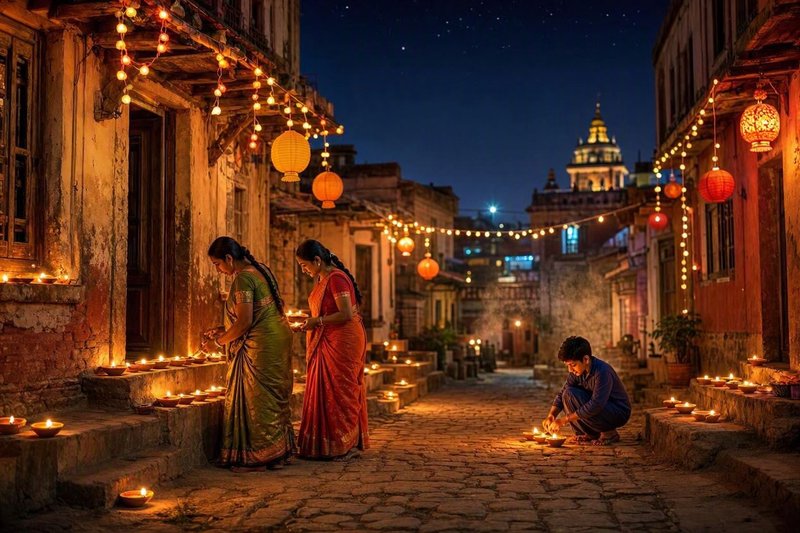
Many Hindu families associate Diwali with Rama’s return to Ayodhya, Lakshmi worship or Krishna narratives. Bengali Shakta communities may foreground Kali Puja, while Govardhan Puja, Bali Pratipada and regional new years extend the season in other directions. These connections can coexist without forming a single uniform ritual.
The Rubin Museum’s overview presents this plural setting. In conversation, ask which tradition your host follows. It is more respectful to listen to a family’s account than to insist that every lamp must represent a story learned from a school summary.
Jain Diwali: Mahavira and liberation
For Jains, Diwali commemorates the nirvana of Mahavira, the 24th Tirthankara, associated with Pavapuri. Nirvana here carries the religious meaning of liberation; reducing the occasion to a generic prosperity festival misses that focus. JAINA’s Diwali material identifies this central connection.
A visitor should allow the community’s devotional and reflective activities to set the tone. Ask about the programme, food arrangements and expectations before joining. Do not assume that a Hindu puja sequence, a fireworks party or a particular gift belongs in the observance simply because it occurs at the same time of year.
When explaining Jain Diwali to children, keep the introduction clear: this community is remembering Mahavira and the significance of liberation. There is no need to force the account into Rama’s homecoming or to add an exact ancient date that may depend on a particular chronology.
Sikh Bandi Chhor Divas: liberation and concern for others
Bandi Chhor Divas commemorates the release of the sixth Sikh Guru, Guru Hargobind, and the liberation of other prisoners. In the familiar Sikh account, 52 princes are able to leave through the Guru’s insistence and a specially prepared cloak. The Sikh Coalition’s educational resource explains the occasion through hope and helping others in difficult circumstances.
The commemoration has its own religious and historical identity even when lights and gatherings overlap with the Diwali season. “Happy Bandi Chhor Divas” is an appropriate greeting. At a gurdwara, follow local guidance on head covering, shoes, seating and participation; volunteers can explain anything unfamiliar.
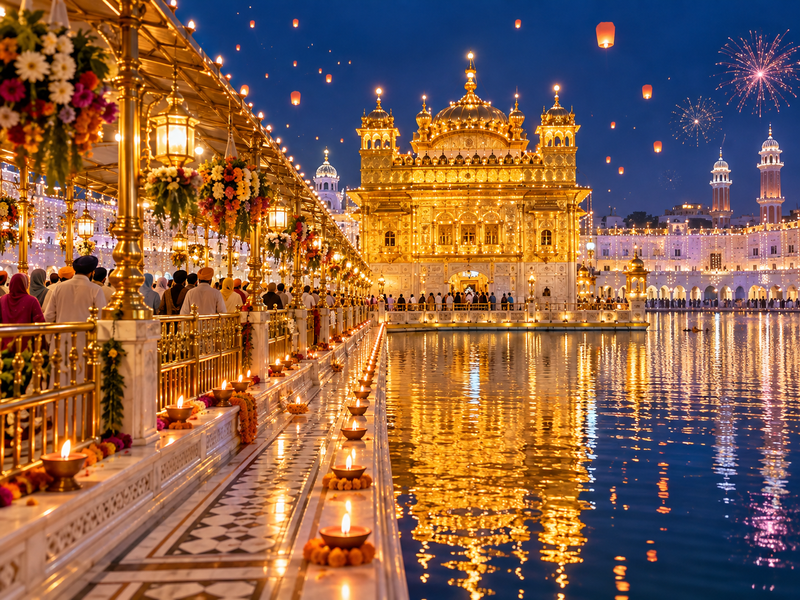
For an introduction, keep the emphasis on liberation and care for fellow people. Avoid describing the observance as merely a Sikh version of a Hindu myth. Similarly, photographs of an illuminated gurdwara should be captioned accurately when the occasion is known.
Tihar and Swanti: the Newar and Nepalese setting
Nepal’s Tihar includes observances involving animals, Lakshmi and sibling relationships. Newar communities also use the name Swanti and observe Mha Puja, commonly described as worship of the self, within their New Year tradition. The Nepal Tourism Board and Rubin Museum’s detailed Tihar article explain this cultural setting.
Newar Buddhist participation is one reason that some accounts mention Buddhist connections with the season. That local context should not be expanded into a claim that all Buddhists celebrate Diwali or share one explanation for it. Nepal itself should also be described as its own national and cultural setting.
A private Mha Puja is a family observance, not automatically a public attraction. Attend by invitation, ask before photographing and follow the host’s instructions. Traditional honours for animals should likewise be approached with care for the animals themselves, without assuming that every human festival food is suitable for them.
A respectful comparison
| Context | A central focus | A useful distinction |
|---|---|---|
| Hindu Diwali traditions | Several deities, sacred narratives and forms of renewal. | No single ritual or origin account describes every household. |
| Jain Diwali | Mahavira’s nirvana. | Liberation has a specific religious meaning. |
| Sikh Bandi Chhor Divas | Guru Hargobind’s release and the freedom of fellow prisoners. | A distinct commemoration within the same season. |
| Tihar and Newar Swanti | Relationships, animals, Lakshmi, Mha Puja and siblings in local traditions. | A precise Nepalese context, not a rule for all Buddhists. |
Join a celebration without making assumptions
Ask what the host calls the occasion, what guests should know and whether there is a prayer, meal or service activity you can join. A respectful greeting and willingness to listen are often more useful than arriving with a memorised explanation of someone else’s religion.
For a school, workplace or interfaith gathering, invite participants to describe their own traditions and make devotional participation optional. Use separate labels for the observances, avoid assigning a single spokesperson to represent everyone, and check photographs and captions before publication. That approach allows a shared celebration to preserve the differences that give it meaning.
Frequently asked questions
Do all communities celebrate Diwali for the same reason?
No. Hindu traditions themselves vary, while Jain Diwali, Sikh Bandi Chhor Divas and Newar observances have distinct religious and cultural meanings.
What does Diwali commemorate for Jains?
It commemorates Mahavira’s nirvana, understood in Jain tradition as liberation. Mahavira is the 24th Tirthankara.
What greeting can I use for a Sikh Bandi Chhor Divas celebration?
Happy Bandi Chhor Divas is appropriate. Ask your hosts about the gathering and follow the gurdwara’s local guidance.
Do all Buddhists celebrate Diwali?
No. Buddhist connections should be described in specific local contexts, including some Newar Buddhist participation in Nepal’s festival season, rather than generalised to all Buddhists.
Sources & further reading
- One Festival, Many Lights: Diwali Across South Asia and the Himalayas ↗
- JAINA Diwali Special Newsletter ↗
- Sikh Celebrations: Bandi Chhor Divas ↗
- Tihar | Nepal Tourism Board ↗
- Tihar: Festival of Lights ↗
Calendar and event information checked 5 November 2026. Recheck local arrangements before attending.