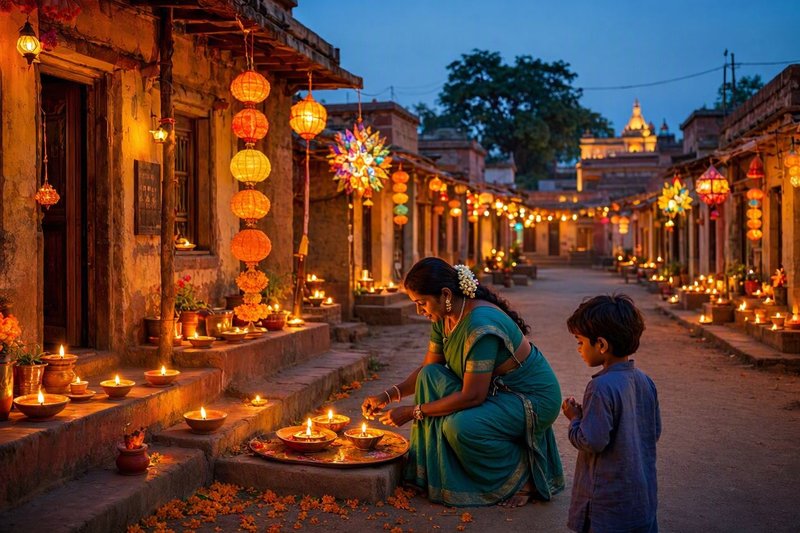
At a glance
- Begin with visible details, then explain stories and traditions in context.
- Use patterns, interviews, and kind actions to make learning active.
- Offer several ways to participate, including a quiet option.
A simple explanation to begin with
Diwali, also called Deepavali, is a festival season celebrated by many people in India and around the world. It is often called the Festival of Lights. Families may light lamps, decorate their homes, share food, visit relatives, pray, or join community gatherings. What happens in one household may differ from what happens in another.
You can explain the idea of light through an everyday example: a lamp helps us see, and learning something new helps us understand. Many Diwali stories connect the festival with hope, goodness, and new beginnings. This is a useful starting point without suggesting that every person tells the same story or follows the same ritual.
Ten simple lines about Diwali
- Diwali is also known as Deepavali.
- It is often called the Festival of Lights.
- Many families light small lamps called diyas.
- People may decorate their entrances with colourful patterns called rangoli.
- Families and friends often share festive food.
- Some households offer prayers as part of the celebration.
- Different regions and communities have different Diwali traditions.
- Stories of light, goodness, and hope are important to many celebrations.
- We can celebrate thoughtfully by caring for people, animals, and shared spaces.
- A kind action can be a meaningful part of the festival.
Talk about stories as stories
In many Hindu families, especially in northern India, Diwali is associated with the return of Rama, Sita, and Lakshmana to Ayodhya in the Ramayana tradition. A child-friendly retelling can focus on the welcome after a long journey and the lamps that express the community’s joy. Introduce it with “One story many families tell is…” so children understand its cultural and religious setting.
Other families connect the season with different traditions and religious observances. Ask, “What does your family do?” and allow “We do not celebrate Diwali” as a perfectly comfortable answer. Do not ask one child to speak for an entire religion, region, or country. A class can learn about the festival without taking part in worship.
Four activities that build understanding
Make a pattern together
Cut circles, triangles, and petal shapes from scrap paper. Let children arrange them around a centre to make a paper rangoli. Ask what repeats, what changes, and how they made the pattern balanced. Photograph the design before reusing the pieces. This connects the festive decoration with observation, colour, and geometry.
Create a family-tradition interview
Invite a child to ask a willing adult three questions: “What do you remember?”, “What food did you enjoy?”, and “What has changed?” The child can draw or write the answers. Offer a community story or a picture-book response as an alternative for children who do not have a family Diwali tradition.
Build a kindness calendar
Draw five paper lamps and write one small action on each: help tidy a shared space, thank a helper, include someone in a game, call a relative, or repair something instead of replacing it. Let children choose actions they can actually carry out. Keep the focus on care, rather than rewards or competition.
Compare a caption and a description
Show a photograph of a lamp or rangoli. Ask children to write a cheerful caption and then describe exactly what they see. This helps them separate feelings from observations. A clear description also teaches them to consider a reader who cannot see the photograph.
Let children ask their own questions
Invite questions about something the child has noticed, such as why a relative uses a particular greeting or how a rangoli pattern is made. If you do not know the answer, say so and ask someone who follows that tradition. Looking for an answer together models curiosity more helpfully than giving a confident guess.
Plan a calm, welcoming celebration
Offer a choice of drawing, listening, writing, and making so different children can participate comfortably. Set aside a quiet place for anyone who finds busy gatherings overwhelming. Ask about food allergies before sharing sweets, and avoid making food tasting compulsory. Use paper decorations and battery lights for classroom crafts; adults should handle real flames and electrical equipment.
Finish with a small reflection: “What did you learn?”, “What surprised you?”, and “What is one kind thing you could do?” There is no need to test children on every ritual. The most useful outcome is curiosity about other people’s traditions and confidence in asking respectful questions.
Frequently asked questions
How can I explain Diwali to a young child in one sentence?
Diwali is a festival season when many families celebrate with lights, food, stories, and time together, although customs differ between households and communities.
Can a school teach about Diwali without holding a religious ceremony?
Yes. Storytelling, art, family interviews, and discussions of cultural traditions can be educational activities without requiring prayer or religious participation.
Are fireworks necessary for a children’s Diwali activity?
No. Paper crafts, patterns, stories, games, and battery lights can make a lively celebration without fireworks.
What should I say if children celebrate differently at home?
Treat those differences as part of the learning. Invite children to describe their own experiences without presenting any one household’s practice as the rule for everyone.