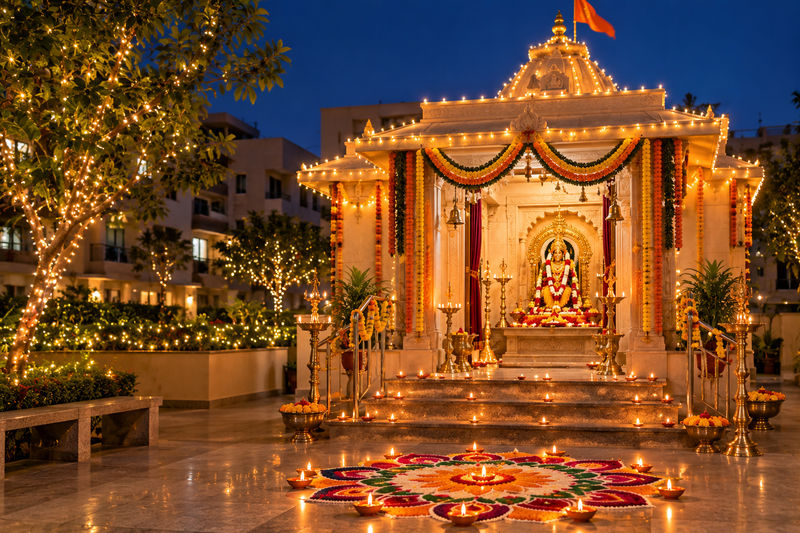
At a glance
- Govardhan Puja and Annakut are related terms with different emphases.
- A manageable food offering can support gratitude and reduce waste.
- Confirm the local calendar and temple contribution rules.
Govardhan Puja and Annakut are closely connected
Govardhan Puja is associated with Krishna and the sacred hill of Govardhan, especially in Vaishnava traditions. Annakut means a mountain or heap of food and describes the devotional offering prepared in many temples and households during this part of the Diwali season.
The terms are related but not perfectly interchangeable. One names a worship tradition centred on Govardhan; the other emphasises the food offering. A temple’s Annakut programme may have distinctive prayers, arrangements and serving customs. At home, a few carefully prepared dishes can express gratitude without imitating the scale of a large display.
The story of shelter beneath the hill
In a familiar devotional account, Krishna encourages the people of Vraja to honour Govardhan and what sustains their community. Indra responds with destructive rain, and Krishna lifts the hill to protect the villagers and their animals. The narrative is a sacred tradition, and its interpretation varies among texts and devotional communities.
For a family discussion, the story offers a way to reflect on protection, humility and dependence on the world around us. Who grows the grain, cares for the animals, carries the food and prepares the meal? These contemporary questions can deepen a celebration without claiming to replace the tradition’s theological meaning. BAPS includes the Govardhan account in its explanation of New Year and Annakut.
The sacred landscape at Govardhan
The story is also connected with a pilgrimage landscape in Braj, around Mathura. Devotees perform parikrama, a devotional circuit of Govardhan Hill, also called Giriraj. Mathura’s district guide identifies Govardhan Puja as one of the occasions for this pilgrimage and lists sacred places along the route, including Mansi Ganga and Radha Kund. Understanding that connection helps explain why a household’s symbolic hill represents a particular sacred place.
Choose the form your household follows
Some families worship before a Krishna image or a symbolic Govardhan form. Others prepare a mound or a small landscape, with materials determined by local custom. A household should ask its elders or temple which form is appropriate rather than assuming that every online photograph describes a requirement.
In a small home, a clean clay representation or another symbol accepted in the family may be easier to manage. Keep decorative materials separate from food preparation and serving surfaces. If children help make a model, explain what it represents and give them a clear workspace so the activity remains respectful and practical.
Plan an offering that can be shared well
Begin with the number of people who will eat and the cooking capacity available. A simple spread might include a grain dish, a vegetable preparation, a savoury accompaniment, fruit and a sweet, adjusted to the rules of the household or temple. Specific ingredients and restrictions vary, so confirm them before cooking.
| Planning question | A useful decision |
|---|---|
| How many dishes? | Choose a manageable number; no universal total is required for every home. |
| Who will prepare them? | Share the work and identify one person coordinating the serving time. |
| What can wait safely? | Use ingredient-specific storage directions and bring out perishable food near the offering. |
| Who will eat afterward? | Plan portions and containers so food can be shared with minimal waste. |
| What does the temple accept? | Ask about ingredients, packaging and delivery before contributing a dish. |
Famous temple spreads can be inspiring, but an impressive photograph is not a household obligation. Likewise, a named offering such as chhappan bhog belongs to particular devotional contexts; do not treat a fixed dish count as a test every family must pass.
A small home sequence
Prepare a clear worship area, arrange the family’s image or symbol and place the offerings neatly. Follow the prayers, reading, songs or aarti used in your tradition. Someone familiar with the practice can explain the Govardhan story before the food is shared as prasad.
Give each participant one simple responsibility. A child might arrange flowers, an older relative might tell the story, and another person can help with serving. Keep the activity comfortable for those who cannot stand or sit on the floor for long. A short observance with attention is often easier for a family to repeat meaningfully.
Visiting a temple Annakut
Read the temple’s current programme and distinguish darshan, aarti and food distribution times. Do not assume that bringing food without notice is helpful: kitchens may have specific preparation standards or a coordinated menu. Ask before making a contribution and follow the volunteers’ instructions on arrival.
Allow others room to view the offering and obtain permission before photographing a worship space. If visiting with children, explain that the display is devotional. Afterward, take only the food you expect to eat and follow the serving arrangements rather than treating the event as an unrestricted tasting table.
Nearby observances have their own meanings
Bali Pratipada and Padwa are also observed around this part of the season in some regions, with traditions linked to King Bali and household relationships. Gujarati New Year brings another form of renewal. They can appear beside Govardhan Puja on a festival overview without being the same observance.
Confirm the date with the calendar or temple your household follows; avoid assuming that every related festival always falls on the civil day immediately after Diwali. Continue with Gujarati New Year or the festival sequence for that wider context.
Frequently asked questions
What is the difference between Govardhan Puja and Annakut?
Govardhan Puja names the worship associated with Krishna and Govardhan. Annakut refers to a substantial food offering, often made during that observance or a temple’s New Year celebration.
Must an Annakut contain 56 dishes?
No universal dish count applies to every household. Particular temples or devotional traditions may follow a named offering, but a home can prepare a modest spread suited to its practice.
Can I bring food to a temple Annakut?
Ask first. Temples may specify ingredients, preparation conditions, packaging and delivery times, or may already have a coordinated menu.
Are Bali Pratipada and Govardhan Puja the same festival?
They are distinct observances that occur around the same part of the Diwali season. Their stories and regional customs should be described separately.
Sources & further reading
Calendar and event information checked 5 November 2026. Recheck local arrangements before attending.