At a glance
- Choose contrasting favourites instead of a long compulsory list.
- Use complete, trusted recipes and a realistic make-or-buy plan.
- Keep storage and ingredient details with each item you share.
A faral plate is an invitation to taste and talk, rather than a requirement to reproduce every item a relative remembers. Start by asking which snacks matter most in your household. One family's must-have may be another family's occasional addition. Treat the assortment as a personal festive tradition, with room for regional and family variations.
Choose a compact assortment with variety
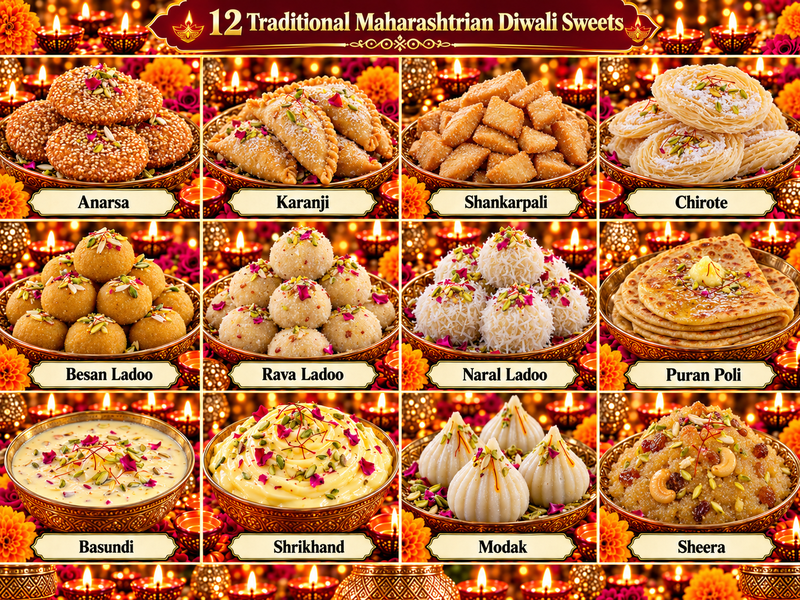
Make a shortlist before planning any cooking. Choose one crisp savoury snack, one mixture, one sweet bite and one extra family favourite if time permits. This gives different textures and flavours without requiring several similar batches. Chakli, chivda, shankarpali and laddoos offer familiar starting points, but the version and recipe should come from a source you trust.
| Place in the assortment | Possible choice | Decision to make |
|---|---|---|
| A crisp savoury item | Chakli made or bought in your preferred style | Is this a recipe you can produce confidently? |
| A loose mixture | A household version of chivda | Which ingredients and level of seasoning suit the people sharing it? |
| A sweet crisp bite | Sweet shankarpali, if that is your family's version | Will it be packed separately from strongly flavoured snacks? |
| A softer sweet | A favourite laddu or another familiar sweet | What storage instructions does this specific preparation require? |
| An optional extra | A family speciality or a shop-bought favourite | Does it add something distinct, or simply add more work? |
Use this as a planning framework, not a definition of an authentic plate. If an elder makes a particular speciality every year, it may deserve the first place in the plan. If nobody especially wants an item, leave it out. A smaller selection that is enjoyed is more useful than full containers prepared out of obligation.
Decide what to make and what to buy
For each item, mark whether you have a tested recipe, the right equipment and a realistic preparation slot. Buying one difficult item can free time for a family recipe you would like to make together. You do not need to conceal that choice; a thoughtful assortment can combine homemade and purchased food.
A recipe title alone is not a cooking method. Use a complete recipe with quantities, preparation details and storage advice. Do not reconstruct a chakli or shankarpali recipe from a photograph or a list of ingredients. If you plan a substitution, check it against a reliable recipe instead of assuming the texture and cooking will remain unchanged.
Plan batches around the kitchen you have
List the equipment each dish needs and identify overlaps. Several recipes may require the same hob, mixing bowl, tray or workspace. Schedule one task at a time where those resources conflict. Keep packaging and gift assembly away from active cooking so the work surface remains available and ingredients do not become mixed with ribbon, flowers or decorative material.
Give helpers specific roles: measuring from the chosen recipe, preparing labels, washing suitable utensils or packing food when it is ready to pack. If children join in, choose a task away from hot cooking and follow age-appropriate supervision. Preserve the part of making faral that people enjoy; there is little value in an ambitious list that leaves everyone exhausted.
Keep the containers and information organized
Use suitable food containers with lids and label each item so similar-looking batches are easy to distinguish. Keep crisp snacks separate from moist sweets and from strongly scented items. Record the preparation or purchase date, the recipe or seller, and the storage directions you are following. Do not assign every snack the same number of days simply because it belongs to one festive assortment.
The World Health Organization's Five Keys to Safer Food emphasize cleanliness, separation of raw and cooked food, thorough cooking, suitable temperatures and safe water and ingredients. Apply those principles throughout preparation. For milk-based additions, the FSSAI guidance on traditional milk products also makes clear that sweets have different storage needs; follow product-specific instructions.
Build a sharing box without losing the details
Pack portions in separate food-safe compartments or containers so the recipient can identify each item. Include ingredient information, especially where nuts, dairy, wheat or other ingredients may matter to them. Ask about their needs before cooking if the gift is intended for someone with a food allergy or restriction. Do not describe a homemade batch as free from a particular ingredient or cross-contact unless that claim is established.
Choose a box size that suits the recipient's household and the time in which the food can be used. A smaller box with clear information is easier to receive than a large anonymous assortment. If a journey cannot meet an item's storage conditions, remove that item from the parcel and select something suitable for the actual trip.
Serve the faral as an occasion
Bring out a small plate with a few choices and offer a drink that suits your guests. Explain an unfamiliar item by its ingredients and texture rather than by insisting that everyone must like it. Replenish from the containers when wanted. Leave room for conversation about who made a recipe, how the family's version differs, or which snack someone hopes to learn next year.
After the gathering, note the favourites, the quantities that worked and the recipes worth repeating. That short record becomes your own faral plan. It preserves useful family knowledge without turning the festival into a growing list of compulsory cooking tasks.
Frequently asked questions
Do I have to make every faral item at home?
No. Choose the dishes you enjoy making and buy others from a reliable seller. A small assortment can still feel personal and generous.
Which items should I begin with?
A compact plan might include chakli, chivda, a sweet bite and one family favourite. Adapt it to your household rather than treating that selection as a fixed rule.
How should I store a mixed faral box?
Keep items separate and follow the specific recipe or seller instructions for each. A shared box does not give all its contents the same shelf life or storage requirements.
Sources & further reading
Calendar and event information checked 5 November 2026. Recheck local arrangements before attending.